/
Knowledge Base/
Gateway Acknowledgement vs Partial Downstream Propagation After DoIP Routing Activation
Knowledge Base
Last Updated: 2026-07-30
Gateway Acknowledgement vs Partial Downstream Propagation After DoIP Routing Activation
This retained window is wider than the ACK-only page: it shows gateway acknowledgement and later downstream-path activity, but does not establish causal propagation or final target completion.
Evidence Summary
Interpret the retained observation before assigning a diagnostic conclusion.
Observed
The retained window shows Routing Activation, gateway acknowledgement of diagnostic payloads, and later lower functional-path activity without a matching physical-target downstream DoIP transmission or final UDS response in scope.
Supported interpretation
The observation extends beyond pure gateway acknowledgement to later downstream-path activity, while correlation with the physical-target request remains unproven.
Not established
Final delivery, target receipt, target execution, causal propagation, OEM behavior, and root cause are not established.
Recommended next check
Collect synchronized downstream capture or gateway-internal telemetry for the same request window and rule out upstream retransmission.
Visual Evidence
These panels are reviewed, public-safe, role-based event summaries. They are not raw packet captures or screenshots.
Gateway Acknowledgement And Partial Downstream Propagation Summary
Public-safe summary generated from the retained evidence window for the gateway-acknowledgement and partial-downstream-propagation article.
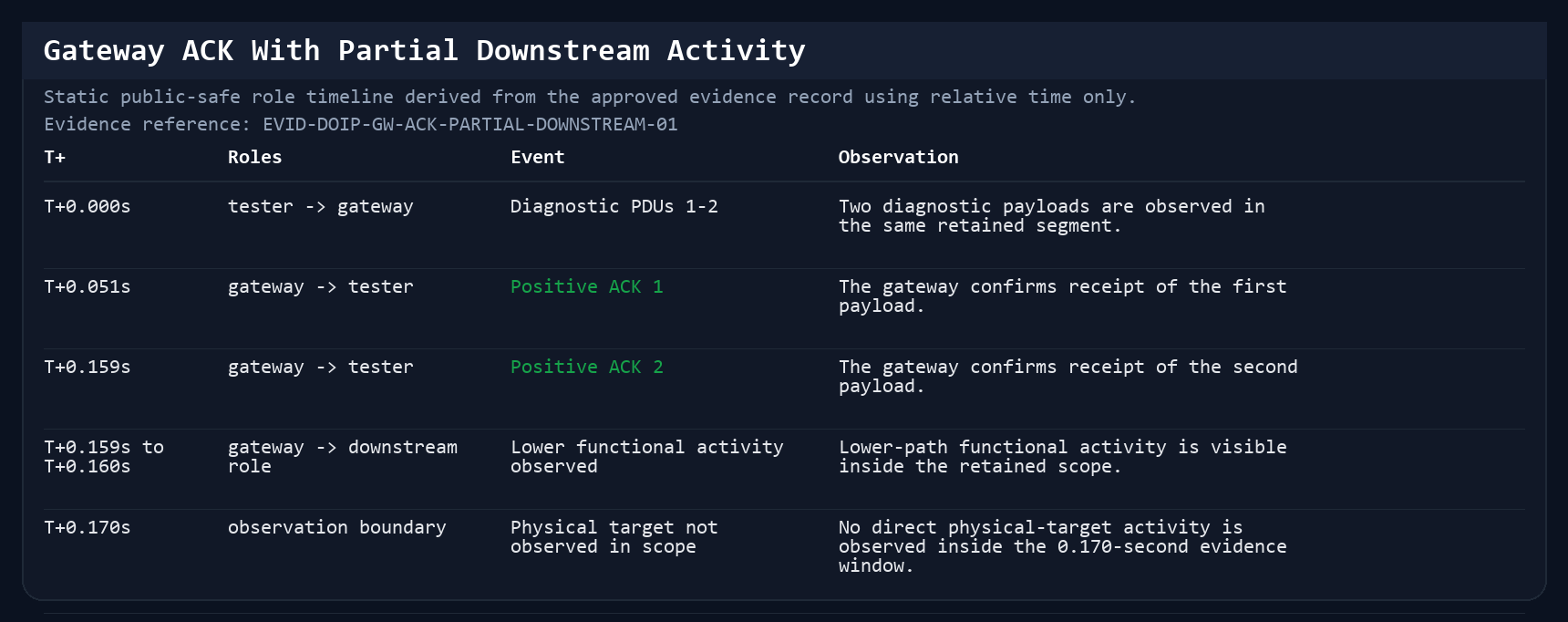
Evidence reference: EVID-DOIP-GW-ACK-PARTIAL-DOWNSTREAM-01
Derived from: retained, reviewed evidence record
Normalized by: public-safe role-based event summary
Original packet count: not published; raw capture remains internal
Timeline
Read this as a role-based swimlane: it shows observed request/response order, not an unproven causal chain.
Observed: The retained window shows Routing Activation, gateway acknowledgement of diagnostic payloads, and later lower functional-path activity without a matching physical-target downstream DoIP transmission or final UDS response in scope.
Not established: Final delivery, target receipt, target execution, causal propagation, OEM behavior, and root cause are not established.
Next check: Collect synchronized downstream capture or gateway-internal telemetry for the same request window and rule out upstream retransmission.
Tester
Gateway / ECU
Evidence boundary
Routing Activation and diagnostic request
Diagnostic payloads acknowledged
Downstream-path activity appears
No target-side completion observed in scope
Priority FAQ
Does downstream-path activity prove the target received the request?
No. It proves only that downstream-path activity was observed after acknowledgement in the retained window; it does not prove that activity was caused by the request.
Evidence patterns
These summaries group approved records without extending what any individual window establishes.
Acknowledgement plus wider downstream-path observation
Problem signal: Any activity after a gateway acknowledgement is read as proof of target receipt.
Observed: Gateway acknowledgement is followed by lower functional-path activity in the retained window.
Supported interpretation: The window is wider than acknowledgement alone.
Not established: That the physical-target request caused the activity, reached a target, or completed.
Next check: Correlate synchronized downstream evidence to the same physical-target request.
Evidence IDs: EVID-DOIP-GW-ACK-PARTIAL-DOWNSTREAM-01
Evidence record details
Capture-Backed Evidence
Each example identifies whether it is a controlled simulator observation or a redacted field-evidence window. The evidence record bounds what the sequence can and cannot establish.
Gateway acknowledgement with partial downstream propagation
Acknowledgement is followed by downstream-path activity
Evidence reference: EVID-DOIP-GW-ACK-PARTIAL-DOWNSTREAM-01
A retained evidence window shows Routing Activation, gateway acknowledgement of the diagnostic message, and lower functional-node activity, yet no matching physical-target downstream DoIP transmission or final UDS response returns before the window closes.
Evidence signals
- Two diagnostic payloads are carried in the same transport segment and each receives a positive acknowledgement at the gateway boundary.
- Role-based lower functional-node activity is observed after acknowledgement.
- No matching physical-target downstream DoIP transmission is observed within the defined capture scope.
Real Timeline
- activation | tester / gateway | Routing Activation succeeds | The control path is active before the diagnostic request window.
- acknowledgement | gateway | Diagnostic payloads acknowledged | The gateway accepts both payloads at the DoIP boundary.
- downstream stage | lower functional path | Downstream-path activity observed | Activity is observed after acknowledgement; correlation with the physical-target request remains unproven.
- window end | observation horizon | No matching physical-target downstream DoIP transmission or final UDS response observed | Completion and fault location remain unproven.
It records a wider observation window than ACK-only analysis while preserving the unresolved correlation and target-side boundary.
Packet Evidence
These packet-level checkpoints are the smallest proof units behind the article narrative.
Activation boundary
tester / gateway
Routing Activation succeeds before the request window of interest.
The control path is open before downstream interpretation begins.
Gateway acknowledgement
gateway -> tester
The gateway positively acknowledges both diagnostic payloads.
This is the same acknowledgement boundary owned by the ACK-only page.
Downstream activity boundary
lower functional path
Downstream-path activity appears without a matching physical-target downstream DoIP transmission or final UDS response in scope.
Activity is observed after acknowledgement, but correlation with the physical-target request and target-side completion remain unproven.
Analyzer Conclusion
This is the condensed engineering verdict the analyzer would put in front of the operator.
Gateway acknowledgement is observed and the same request window also shows downstream-path activity beyond pure entity acceptance.
Do not claim final delivery, target receipt, or root cause without synchronized downstream evidence.
False Positives
These are cases where the tool symptom can point in the wrong direction unless the packet timeline is checked.
Symptom: Any downstream-path activity is treated as proof of target receipt.
Packet truth: The retained window proves acknowledgement and later downstream-path activity, not that the request caused that activity.
Risk: The fault is over-located to the target side without a final response or synchronized downstream evidence.
Symptom: The ACK-only page is reused even though the window contains downstream-path activity.
Packet truth: This article owns the wider evidence boundary.
Risk: The analysis omits the observed downstream activity while still not establishing request propagation.
Decision Tree
Use this order in real troubleshooting so packet evidence narrows the branch before repair effort expands.
- 1. Confirm Routing Activation and gateway acknowledgement belong to the same request window.
- 2. Check whether downstream-path activity appears after acknowledgement.
- 3. Record whether any matching physical-target downstream DoIP transmission or final UDS response is observed before the retained window ends.
- 4. Obtain synchronized downstream evidence before naming a target-side fault.
Common Misreads
These are the interpretation traps that real packet evidence helps avoid.
- Downstream-path activity is not the same as a final target response.
- This wider boundary does not identify which downstream component stopped the request.
When This Case Applies
Use this case when one retained Ethernet observation window contains multiple complete diagnostic PDUs in one TCP segment, and the gateway positively acknowledges each PDU.
The comparison requires downstream activity matching the functional request and no matching physical-target downstream DoIP transmission within the documented window and capture scope.
Evidence Boundary Difference
This page starts after Routing Activation and after the gateway acknowledges the diagnostic message.
Unlike the No Final UDS Response Observed After Routing Activation guide, the selected window also contains downstream-path activity beyond pure entity acceptance.
That moves the observation boundary farther than acknowledgement alone, but not far enough to prove final target completion.
When the ACK-Only Page Is Still the Right One
Use the ACK-only guide when your retained window ends at gateway acknowledgement and contains no downstream-path activity.
That companion page intentionally stops at DoIP message acceptance and does not claim forwarding or target-side handling.
What the Observed Downstream Activity Establishes
A downstream-facing activity marker is observed after the gateway acknowledgement in the same retained window.
The capture does not establish that this activity was caused by the physical-target request or identify which downstream component received, processed, delayed, or dropped it.
Alternative Explanations Still Open
No matching physical-target downstream DoIP transmission is observed inside the defined capture scope, so final delivery remains unproven.
An upstream retransmission can remain an alternative explanation for the observed boundary and should be ruled out before naming a downstream fault.
More Frequently Asked Questions
How is this different from the ACK-only page?
The ACK-only page stops at DoIP entity acceptance. This page owns the wider window where acknowledgement is followed by downstream-path activity but still no final target-level completion proof.
Related Diagnostic Guides
Use nearby guides to move from protocol filtering to root-cause troubleshooting without leaving the knowledge base.